Power of Story: Resources, Readings, and Reflections
This page contains resources on the Power of Story, as well as our posts on the topic and some suggested reading. What does that entail? Stories hold deep cultural, political, and personal power. They are especially important as a method of nurturing and resistance for those of us existing outside the mainstream. The resources and readings on this page explore the many ways stories (and storytelling) empower and uplift us.
Table of Contents
Experiencing a crisis and want immediate help? Check out our crisis resource page, which provides easy-to-navigate options. If you are in immediate danger and feel safe to do so, please contact your local emergency services.
If you’d like to read more of our thoughts, here is a carousel of some of our most recent posts on sapphic and trans femme relationships. Below that are further resources and suggestions. You can also see all of our posts on this topic at its category page.





Resources on the Power of Story
Want to learn more about this topic? These are educational resources that we have personally vetted—no spam to be found here. If you’re still new to this topic, start with the resources on the first list. For those more familiar, the second list has more in-depth resources.
Covering the basics:
- Why Intersectional Stories Are Key to Helping the Communities We Serve (Annie Nemand et al., Stanford Social Innovation Review)
- The Power of Storytelling (Brandon Hooks, HRC)
- The Danger of a Single Story (Chimamanda Ngozi Adichie, TED)
- Queer Activists: Learn How to Harness the Power of Storytelling Here (them. and GLAAD)
- The Carrier Bag Theory of Fiction (Ursula K. Le Guin)
A deeper dive:
- Breaking Silence: How Storytelling Amplifies Marginalized Voices and Sparks Action (Ramesh Meda, Meda Foundation)
- The Tretter Transgender Oral History Project (University of Minnesota)
- GLSEN’s Latest Research Brief Demonstrates the Power of Inclusive Learning for LGBTQ+ Youth (GLSEN)
Do you know of other resources that would be a good fit for this list? Reach out to ash@ashtonrosewrites.com, and we’ll take a look and let you know if we want to add it!
Recommended reading:
(and viewing, listening, etc.)

Storythinking by Angus Fletcher
“Every time we think ahead, we are crafting a story. Every daily plan—and every political vision, social movement, scientific hypothesis, business proposal, and technological breakthrough—starts with “what if?” Linking causes to effects, considering hypotheticals and counterfactuals, asking how other people will react: these are the essence of narrative. So why do we keep overlooking story’s importance to intelligence in favor of logic?
This book explains how and why our brains think in stories. Angus Fletcher, an expert in neuroscientific approaches to narrative, identifies this capacity as “storythinking.” He demonstrates that storythinking is fundamental to what makes us human. Artificial intelligence can perform symbolic logic, rational deduction, and mathematical calculation, but it is incapable of deliberating in narrative. Drawing on new research in neuroscience and narrative theory, Fletcher explores the nature of imagination, innovation, and creativity. He provides concise answers to big questions: How does storythinking work? Why did it evolve? How can it misfire? What problems can it solve?
Revealing the significance of storythinking from science to business to philosophy, this book also provides ways for readers to harness its power to script better tomorrows.”

The Magic Words by Cheryl B. Klein
“Great children’s and young adult novels offer their readers both wonderful outward adventures and stirring inward journeys. In The Magic Words, Cheryl B. Klein draws on fifteen years of experience as an editor to guide writers on an enjoyable and practical-minded journey of their own. She provides a complete overview of the writing, editing, and publication processes, from developing a saleable premise for a novel to querying your dream agent. She also explains the differences in content and approach for middle-grade vs. young adult novels, and discusses vital contemporary topics in the field like self-publishing, world-building, and creating diverse characters. The book delves deep into the major elements of fiction—intention, character, plot, and style—while its original exercises, thought-provoking questions, and solid rules of thumb help writers apply its insights to their individual creative work. With its generous tone and useful tools for story analysis and revision, The Magic Words is an essential handbook for writers of children’s and young adult fiction.”

Craft in the Real World by Matthew Salesses
“The traditional writing workshop was established with white male writers in mind; what we call craft is informed by their cultural values. In this bold and original examination of elements of writing—including plot, character, conflict, structure, and believability—and aspects of workshop—including the silenced writer and the imagined reader—Matthew Salesses asks questions to invigorate these familiar concepts. He upends Western notions of how a story must progress. How can we rethink craft, and the teaching of it, to better reach writers with diverse backgrounds? How can we invite diverse storytelling traditions into literary spaces?
Drawing from examples including One Thousand and One Nights, Curious George, Ursula K. Le Guin’s A Wizard of Earthsea, and the Asian American classic No-No Boy, Salesses asks us to reimagine craft and the workshop. In the pages of exercises included here, teachers will find suggestions for building syllabi, grading, and introducing new methods to the classroom; students will find revision and editing guidance, as well as a new lens for reading their work. Salesses shows that we need to interrogate the lack of diversity at the core of published fiction: how we teach and write it. After all, as he reminds us, ‘When we write fiction, we write the world.’”

Story Genius by Lisa Cron
“It’s every writer’s greatest fear—pouring blood, sweat, and tears into writing hundreds of pages only to realize the story has no sense of urgency and no internal logic, so it’s a complete do-over.
The prevailing wisdom in the writing community is that there are just two ways around this problem: pantsing (winging it) and plotting (focusing on the external plot). Story coach Lisa Cron has spent decades discovering why these methods rarely work and coming up with a powerful alternative, based on the science of what our brains are wired to crave in every story we read (and it’s not what you think).
In this revolutionary guide, Cron helps you crack the story code and create a novel, screenplay, or memoir that will keep readers riveted. Using one novelist’s evolving story as an example throughout, Story Genius takes you step-by-step from the first glimmer of an idea to an expansive, multilayered cause-and-effect blueprint—including fully realized scenes. By plumbing the nitty-gritty details of your raw idea to organically generate your story’s internal logic, meaning, and urgency, you’ll end up with a first draft that has the authority, richness, and command of a sixth or seventh.”
HIV Cure Research Day: The Power of Storytelling by Amanda Hurwitz, GLAAD
“GLAAD recognizes the ability of fair, accurate and consistent representation in media to eradicate HIV stigma and bridge generational gaps. In celebration of this historic day, GLAAD is amplifying some essential statistics and stories centering people and/or characters living with HIV, as well as their experiences with HIV cure efforts.”
Seven Speculative Stories About the Power of Stories by Alix E. Harrow
“What unites people? Armies? Gold? Flags? Stories. There’s nothing in the world more powerful than a good story.
Look. It’s not a good line. It’s an unsupported thesis, wildly out of place in a show that brutally mangled most of its own plotlines in the name of grim realism, or maybe just cool CGI. There’s also a certain degree of cringe involved when a storyteller has one of their characters talk about the importance of storytelling; one can’t help but see the puppet strings.
And yet, watching the final episode of Game of Thrones, I teared up a little. I’m not proud! I just have a helpless biological response to anyone who suggests—in any context, at any time—that stories matter. Because they do, to me, very much. So what could be better than stories about stories?”
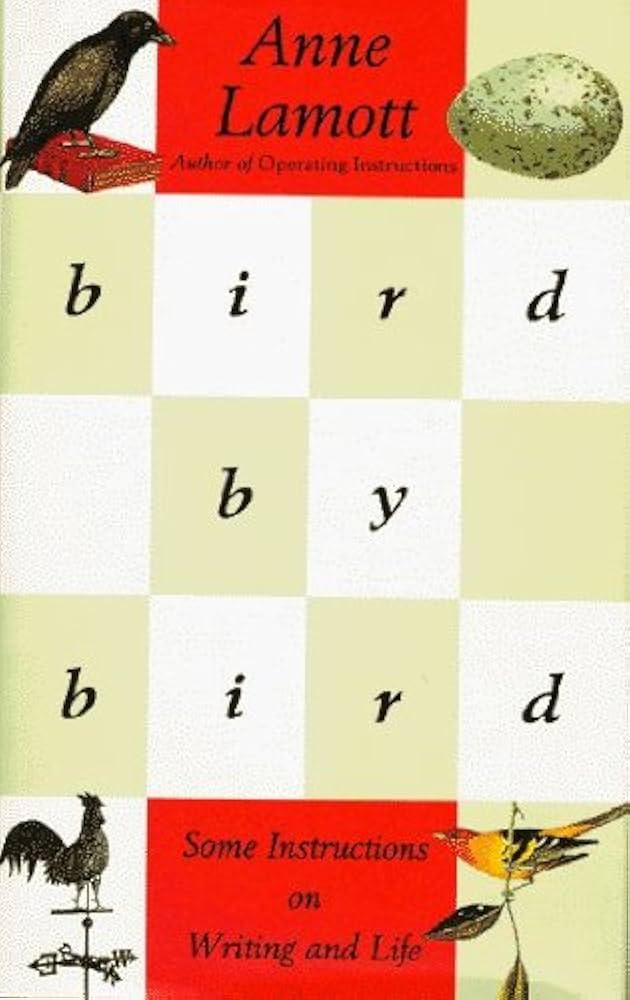
Bird by Bird by Anne Lamott
A brilliant blend of advice that applies as well to the desperate writer as it does to the struggling teen. Lamott’s views on storytelling apply to so much more than the work of writers, delving into the realms of life, connection, and personal narrative.
Including my own books:
Each of these topics is important to me, which also means they show up in my own novels. For suggestions on which book is best for you, see my guide on where to start with my novels.
If you like reading stories within other stories, check out “My Year Zero,” in which the main character is part of a group of teens telling a science fiction space opera together.