A collage of LGBTQ authors and books with the progress pride flag in the background

Rachel Gold’s 2025 Recap: Highlights and LGBTQ+ Insights

For many in America, 2025 was a year that stretched on for a very, very long time. So many things happened, and Rachel and I were no less busy. Throughout 2025, we wrote blog posts, released new resource pages, and tackled the Big Themes of current LGBTQ+ politics. Check out some of the highlights of the year below.

Continue Reading

Taking care of yourself in tough times — a guide for the neurodiverse

You might not need this post, but I do. It started as a note to myself about what works. Some of it might also work for you. And I’m sure I missed some things. Feel free to add in the comments. If you’re like me, you’re different from a lot of the people around you: You might have more trouble letting go of obsessive negative thoughts You might get easily triggered into traumatic states You might be prone to spirals of anxiety or depression that are really hard to stop You might feel that you’re the one responsible for fixing the world You might absorb feelings and energy from the people around you, even if it makes you sick One great thing is that you know this about yourself. Also there are a lot of simple steps you can take to be strong and healthy. Here's my list: Disconnect from stressful inputs Turn. It. Off. Whether your stressful input of choice is TV news, Internet news, Twitter, you can turn it off. Turn off notifications. Turn off integrations (like Facebook chat linking to your phone’s texting). Do not let disturbing information catch you off guard. You can look at it when you’re well and ready and feeling powerful. You can

Continue Reading

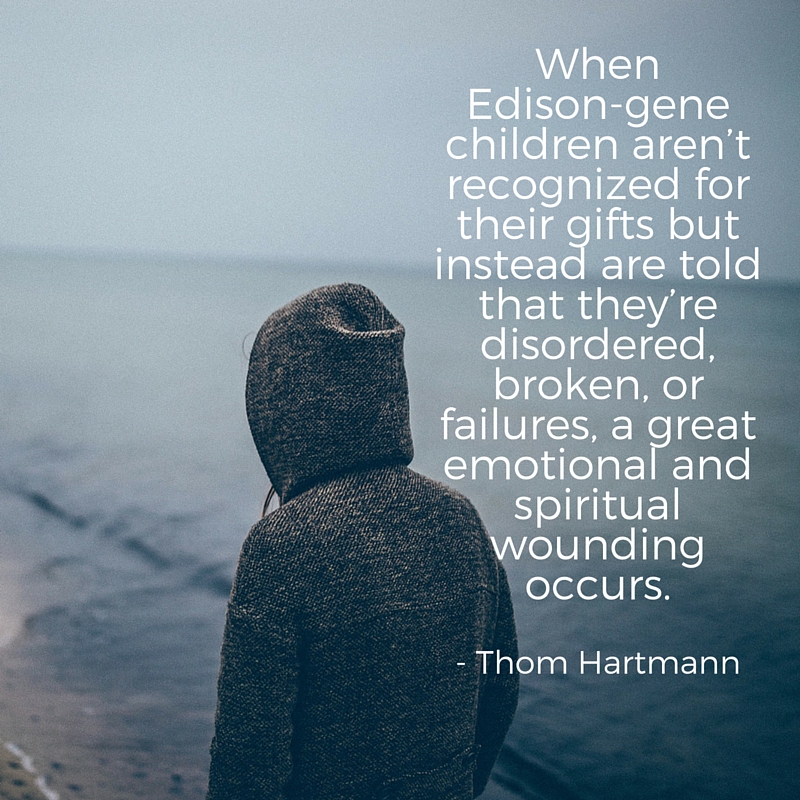
Book Insight: ADHD and the Edison Gene

I first read Thom Hartmann in my mid-20s when I was informally diagnosed with ADD. I was highly anti-meds at the time so there didn’t seem any point in getting officially diagnosed. Plus I wasn’t convinced that it was a disorder. (I’m still not.) Hartmann’s books helped me understand how to choose environments that suited me and helped me be kind to myself when I didn’t fit with cultural expectations about work. This latest, "ADHD and the Edison Gene," takes his initial ideas and updates them with more current science. Instead of describing ADD brains as hunters (in a hunter/gatherer vs. farmer paradigm), he’s using the “Edison gene” and inventors. I’m a fan of all of it. I don’t care if you think of me as an inventor, a hunter or a superhero as long as it’s positive and creates an environment where we can do our best work together. In very brief summary, this book posits that what our culture labels ADD/ADHD arises from a combination of factors that includes a genetic trait for novelty-seeking, a mismatch between innovative brains and our assembly-line culture, and possible environmental factors, like diet. Many of the traits of ADD are positive and adaptive in the

Continue Reading

Book insight: FAST MINDS

FAST MINDS is a great book for people with ADHD/ADD that does not pathologize our diverse brains. The authors write: Having FAST MINDS traits can mean there is a mismatch between the way the brain works and the demands of life. It’s a way of thinking and being that makes it harder to function in today’s world. The is the single most pragmatic and actionable ADHD book I’ve read in the past few years. I found a lot of it extremely useful. Some of the tips I’d already implemented over the years, but even then they usually had good input. If you need to skip science and theory for now and start making changes in your life to make it more workable, start here. It’s also got helpful information for partners and family members of people with ADD/ADHD or FAST MINDS (they’re used interchangeably in the book). If you’re wondering what FAST MINDS stands for, here’s the list from the book, slightly abbreviated: FORGETFUL: Do you forget what people have told you? Do you forget where you put things? Do you need reminders for every day things? ACHIEVING BELOW POTENTIAL:Do you feel you should be getting better grades than you do at school, or should have

Continue Reading