
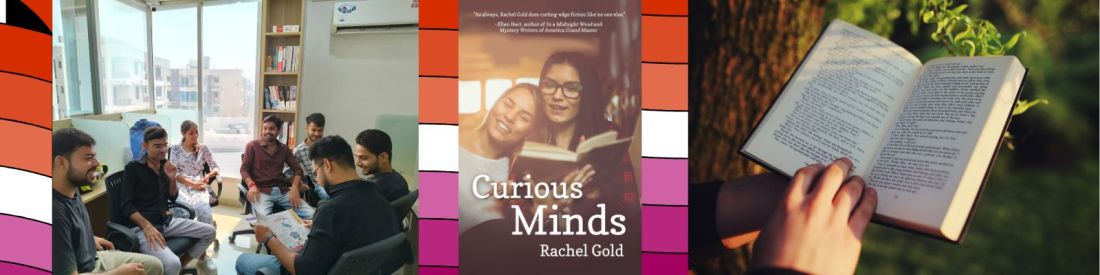
Curious Minds Reading and Discussion Questions
Here is a list of discussion questions for Curious Minds, intended for classrooms, book groups, scholars, or enthused readers. Following the questions are a few bonus exercises you can try out if you want to engage even more deeply with the text.
Warning: The further you get in the questions, the more spoilers there are! I don’t recommend reading the questions until after you’ve finished that chapter/section. However, bonus exercises #1 and #2 are spoiler-free and could be read whenever (and sufficient space has been included so you shouldn’t see the questions preceding it if you click the heading in the TOC). Exercise #3 contains a quote that may be a tad spoilerish.
Table of Contents
Discussion Questions
Chapters 1-3
During Bas and Kai’s fight about Bas’ new work, Lys assumes that because of Maze’s knowledge of queer theory, she’d be “cooler about accommodations.” In your experience, does this assumption often prove to be true with different realms of theory and activism? Why or why not?
Maze and Lys help get Bas home safely, even though both characters have deep tension with Bas. Would you do the same thing? What does this scene say about solidarity in marginalized communities?
Chapters 4-6
Maze and Lys each have worries about the expectations around relationship progression and whether they’re doing things “right.” Have you experienced these same expectations? What types of relationships are usually the model (in media) for those expectations?
Kai and Maze have very different reactions to Lys’ pain. Where do their reactions come from? How does Lys feel about each of them?
On pp. 56-8, Maze and Lys present different metaphors for understanding ADHD and the benefits and downsides of meds. What do you agree with, disagree with, and/or wonder about from these conversations?
Chapter 7
In “The Uses of the Erotic: The Erotic as Power,” Audre Lorde writes, “The erotic functions for me in several ways, and the first is in providing the power which comes from sharing deeply any pursuit with another person. The sharing of joy, whether physical, emotional, psychic, or intellectual, forms a bridge between the sharers which can be the basis for understanding much of what is not shared between them, and lessens the threat of their difference.”
How does this chapter explore and expand these ideas?
Chapters 8-9
Consider the accommodation assignment Professor Leland gives on pp. 76-78, and the many solutions offered. What do you think of these solutions? How would you approach the assignment?
On p. 98, Sophi introduces the concept of “sensory dumping.” What do you make of this, and Maze’s reaction? Think of examples of other methods of sensory dumping.
Chapters 10-12
Consider the introduction of Karl and the reveal of who his boyfriend is. How did your expectations about the character compare to his real self? What stereotypes or expectations are being subverted here?
The dinner table argument and Maze and Lys’ continued fight share many similarities. In both of these situations, is there a “right” answer? What are each of the characters searching for? Discuss how you would approach these topics.
At the end of chapter 12, Kai introduces Lys to a new system for helping with her room. How does this system compare to the types of “solutions” usually offered in mainstream media?
Chapters 13-14
Consider the definitions of strength and weakness given on pp. 128-130. How would you define those words? Has your answer changed reading this book?
We are about halfway through the story; what direction do you think it is going to go? If you’ve already finished the book, did the resolution follow the path you thought it would take?
Chapters 15-17
“We’re all neurodivergent but in different ways—and the way we adapt is different,” Lys says on p. 175. There are multiple visualizations and models of neurodivergence in these chapters. Discuss these models and what you might add or remove from them; or make your own model.
Chapter 16 features an awkward but grounded sex scene. How does this compare to similar scenes of LGBTQ+ intimacy you’ve seen? Why do you think the author included this scene?
Chapter 17 gathers most of the main LGBTQ+ characters in the book together. Were you surprised by the diversity of characters in the room? Why or why not?
Chapters 18-20
In chapter 18, Lys talks about going beyond just accommodations, including creativity with adaptations. Then in chapter 19, we see her messing up things in her room as a form of regulation. How are these ideas connected? How does Maze react, in both scenarios, and what do you make of that?
Kai and Sophi, previously miffed about being teammates, grow closer through Kai’s fanfiction. What are other ways characters form connections in this book? Do you see those same spaces/topics as an avenue for LGBTQ+ connection in real life?
Chapters 21-22
Here we see more explanations of how the characters connect thoughts internally and externally, as well as their own neurotypes. Did anything in Sophi’s lists surprise you? What would you add to these lists, or to a new one?
Maze struggles with giving Bas the fake clue, reflecting on their history and her priorities. Think back to the solidarity discussed at the beginning of the book. How has that evolved? Would you have done something different, having only the information Maze had?
Chapters 23-25
Nearing the end of the book, the meaning of all the clues is discovered. How did the author connect the themes and questions the characters considered throughout the hunt? How were these themes present for the characters outside the texts they read?
Maze tells everyone to look at all the books “with your heart. What do you see?” Each character names different but related ideas. What do their responses show about the characters? Why do they each focus on those ideas?
Chapter 26
When the true treasure hunt spy was revealed, how did you react? What does it mean for a person in a role of support to betray students in that way?
The characters realize they are the bridges referenced in the clue, and are able to retrieve the box because they work together. Why do you think the author chose that as the central element of the hunt? How does it relate to the experiences of LGBTQ+ folks right now?
Maze, Lys, and Bas intentionally try to shield Kai and Sophi from the campus police officer. Why do they do so? Why did the author include this scene?
Chapter 27
Maze ends the book describing Lys: “She’s relaxed into herself, broader and stronger than before. We all are.” Do you see this as true for the characters? In what way? Were there character changes you were hoping for that didn’t happen?
With the description we’re given, what do you make of Sophi and Maze’s apartment? How does it build on the journey of these characters?
(post continues below)
Want to receive once-a-month updates from me, directly in your inbox? Add your email below to subscribe to my newsletter. To prevent spam, you may get an email asking you to confirm your subscription.
(filler space to prevent spoilers)
—
—
—
—
—
Bonus Exercises
1: Principles of Disability Justice
Read through Sins Invalid’s 10 Principles of Disability Justice. Reflect on how you see these principles demonstrated, or not, throughout the book. Can you connect specific characters, chapters, or moments to specific principles?
2: The Reading List
Create a list of all of the LGBTQ+ books, authors, and other media and creatives mentioned in the book. Reflect on the following questions:
- What entries did you already know, and which are new to you?
- What entries surprise you?
- Are there creators or pieces of media you think are missing from this list?
- Do you feel that there are identities or experiences that fall under the American LGBTQ+ literature umbrella that aren’t represented here?
Then, try modifying this list with your own additions and changes. Or, create an entirely new list with a different theme or focus.
3: A World of Lesbian Literature
On p. 233, Maze says, “I don’t need the money. I need… to have done this. I need to prove it was important, to live in a world where lesbian literature and fortunes and all our various kinds of brains intersect.”
Reflect on these questions:
- What does it mean for lesbian literature, fortunes, and various kinds of brains to intersect?
- What would this kind of world look like? What details come to mind when you think of it?
- What are the values that would be needed for this kind of world to flourish?
Then, reflect on our current world. What are the similarities and differences between our world and this imagined one? How/Could we see that imagined world come to be in our world? What changes would be needed to do so?
What did you think of these questions? Do you want to share an answer to one of them? I’d love to hear from you! Let me know in the comments on this post if you’re so inclined.
Want to receive once-a-month updates from me, directly in your inbox? Add your email below to subscribe to my newsletter. To prevent spam, you may get an email asking you to confirm your subscription.
No Comments