
December 2025 Newsletter: Crochet, Containers, and Creative Adaptation
Welcome to this month’s newsletter! Each month, I try to share what I’ve been up to, what things I’ve published that month, and exciting news if there’s any to be shared.
News and updates
December is a month of slowing down, but we’ve still had some things going on! Our final resource hub on the Power of Story went live last week, so give that a browse, and as always, let us know if you have any suggested additions!
Blog posts from this month

As we wrap up the year, we wanted to share a Queer/Trans Elders Reading List containing some of the texts and creators that have been most influential on our understandings of queer- and trans-ness. This is by no means an exhausting list, so if there are works or people you’d like to see added, drop them in the comments on that post!
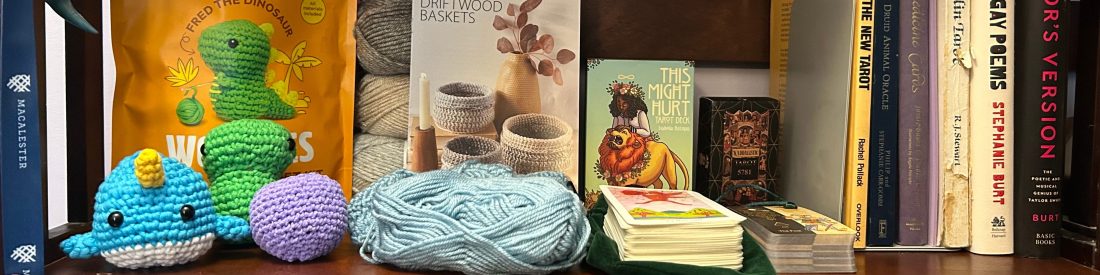
This month I started learning to crochet. Someone sweet got me some crochet kits and I’ve made a tiny whale, part of a dinosaur, and a ball from a pattern I found online. But here’s the thing—I’m not just learning crochet because it’s fun (though it is). I very quickly realized I needed to switch to my left hand because I have a fair number of issues with my right shoulder.
I’ve tried to learn to write with my left hand before, which was incredibly difficult because my right hand is already so skilled at it. But since neither of my hands knew how to crochet, it was easy to switch over after one project and start fresh with my left hand. Plus I saw a great video by a one-handed crocheter demonstrating how to hold the hook and the yarn in the same hand. Now I’m working on learning one-handed, left-handed crochet for times when my right shoulder is too sore to hold the work.
I offer this as an example of fun adaptation. I recently did an interview with a Macalester student about LGBTQ health, and one of the key things they took away was how much adaptation there is in my life. The thing is, it really works—my hypermobility isn’t a disability when I can adapt for it.
The Bedroom as Container
Which brings me to something else that’s been happening this December: I’ve been rethinking my bedroom as a container.
You may or may not know that I have a work bed in my office instead of a chair—it’s much easier for me to sit with my legs extended and my back at an angle. This is much gentler on my joints. So instead of a desk with a chair, I have a desk with a bed (not the bed I sleep in, but an occasional guest bed). [Ashton adds: I’ve adopted this same practice and it has been incredible!]
Except, as you may also know, my dog has been having mobility issues and can’t use stairs anymore. So this month I finally decided to bring my desk down to my actual sleep bed so I can work next to my dog rather than trying to carry her up the stairs or feeling crappy because we’re in the same house but not the same room. Moving my work desk down to the main bedroom has actually been lovely. I have a bedspread that I toss over it to signal to my brain: “This is the work bed as compared to the sleep bed.” I don’t know how much of a difference that makes, but it feels like a good ritual to get into a working mindset.
So now I’m spending a ton of time in this one room—the bedroom-office—and I’ve become more aware of what I can see when I’m working. Some things are inspiring, some things… are not.
Containers and Clutter Threshold
I recently read Dana K. White’s Decluttering at the Speed of Life: Winning Your Never-Ending Battle with Stuff. She created the “Container Concept,” which has been very powerful for me: organizing around containers, or setting up my life as a series of containers. I can choose the size of my containers.
White writes about how “containers are limits,” and says:
They keep stuff under proper control by preventing and limiting the expansion of that stuff. … the purpose of a container is to contain, I saw that though the container held the scarves, its most important purpose was to limit the number of scarves I kept. Once the scarf container was full, I knew how many scarves I could keep.
She also talks about how everyone has a personal “Clutter Threshold” — and I’d add to this that the clutter threshold can vary from room to room. My sunroom has a much higher clutter threshold than my bedroom/office. Neurodivergent folks may want to think about having high clutter spaces for high stimulation when that’s needed, and low clutter spaces when we need low stimulation environments.
Within White’s framework, I think of my bedroom-office as a very specific container. The living room has a different purpose, so it’s a different kind of container. The bedroom-office container—or any office container—part of its purpose is to be calming and inspiring and make it easy to get work done, to do writing. That’s been true for my office room/container for a long time, I now have better words to describe why it’s important to be mindful of what I can see from my desk. And now we’re just doing an extended version since my office and bedroom are the same room. What I can see from my bed/desk needs to be soothing and inspiring.
This has led to a reorganization of some parts of the room—not major, just reorganizing some shelves that I can see from my vantage point when I’m working. This includes making sure I can see the cute crochet kits and the crochet animals I’ve made and am making, to remind me of play and craftiness.
It’s also helping me in rethinking my electronic storage spaces. Just because I can have a cloud drive with 2TB of space does not mean that I want to keep 2TB of materials! Using containers like file folders and Trello boards is helping me constrain my sprawling online storage so that I can actually find the materials I most want to use.
A note: If you look up Dana K. White, you’ll see she has a book with Jesus in the title. From what I’ve seen online, she doesn’t appear to be an anti-gay Christian and doesn’t seem to push a lot of Christian content in her general organizing work. I found Decluttering at the Speed of Life to be accessible and workable for me, but I’m putting a note here because I know there are LGBTQ folks who have been harmed by Christianity. I want to acknowledge that and give you a heads-up that if you go looking at her stuff online, there is some Christian content.
Another Essential Resource
I also wanted to mention How to Keep House While Drowning: A Gentle Approach to Cleaning and Organising by KC Luck, which is my general go-to manual for surviving in a house with cleaning, clutter, and organization. I know the holiday season can be a time when we bring more stuff into our houses and things get chaotic because people come over, we have events, we cook a lot potentially. So How to Keep House While Drowning is pretty highly recommended. The author’s online presence is great too.
What I use most from that book is conversations between present, future, and past me. I will literally have a conversation with myself like, “Okay, tomorrow-me, how do you feel about me doing the dishes or not doing the dishes tonight?” And then if I wake up in the morning and I did do the dishes, I’ll actually say, “Thank you, past-me. I appreciate it.” It works surprisingly well. It’s a great way to acknowledge myself across time.
Also revolutionary: it is okay to load the dishwasher with a few clean things still in it. You know those odd-shaped things that are a pain to put away because they go in some weird drawer? If it’s the end of the day and I’m really tired and the dishes need to go in and there’s a weird-shaped thing still in the drying rack—who cares? I will put the dirty dishes around it. It can get washed twice.
I think her position is really important: first, that cleaning tasks and care tasks are morally neutral. We’re not bad if we don’t do them. There may be consequences if we don’t, but we’re not bad humans. So we can just think about the consequences without getting into the morality of it, which is incredibly useful. She’s also got a good five-part way to clean rooms that I don’t do all the time, but at this point I think I automatically do parts of it.
Here are some key quotes from KC Luck:
Your space exists to serve you. … success depends not on having strong willpower, but in developing mental and emotional tools to help you experience the world differently.
The good news is that you can simply choose to assign your chronic laundry pile a completely different meaning. Instead of thinking, ‘I can never keep up,’ instead say to yourself, “I am so grateful to have so many clothes.” … Let me tell you what the mess in my home means. It means I’m alive. Dirty dishes mean I’ve fed myself. Scattered hobby supplies mean I am creative.
Instead of… Try saying:
Chores → care tasks Chores are obligations. Care tasks are kindness to self.
Cleaning → resetting the space Cleaning is endless. Resetting the space has a goal.
It’s so messy in here! → this space has reached the end of its functional cycle
It’s so messy in here feels like failure. This space has reached the end of its functional cycle is morally neutral.
Good enough is good enough → good enough is perfect
Good enough is good enough sounds like settling for less. Good enough is perfect means having boundaries and reasonable expectations.
So … Happy Holidays!
I’m wishing you a lovely winter holiday season, whatever that includes for you. I’ll be over here making smaller containers, sometimes literally with crochet. (I did get a cool kit for making baskets.) Also wishing us many sanity and comfort victories throughout this season!
Stay tuned next month for more blog posts, our final resource hub, and another newsletter. Thanks for being a reader!
Reading this post on the blog? Enter your email to receive future newsletters right to your inbox! And encourage your friends to subscribe if you think they’d enjoy.
No Comments