For LGBTQ+ People, It Has Been Worse. Here’s How We Persevere
The last few months have been rough for the LGTBQ2SIA+ community in the US (I say in a tone of dramatic understatement). As a storyteller, I’m aware of the stories we’re telling ourselves about recent changes— and how they impact our ability to thrive and achieve the changes we want.
I’ve noticed some people saying that the current political situation is the worst it’s ever been. People have been saying this leading up to the election and after it— most notably in fundraising requests. I don’t think that’s a helpful perspective and may be harmful in terms of demotivating people.
So why do we feel this way? One answer is that for young people, this may be the worst you’ve ever experienced. It makes sense to feel afraid, angry, discouraged, and anything else you’re feeling. Another answer comes from a recent study showing that Americans struggle to perceive the extent and direction of change in this country.
The graphic below comes from “Widespread Misperception of Long-Term Attitude Change” by Adam M. Mastroianni and Jason Danab. In the charts, the orange lines represent what participants thought attitudes were at the times in question— and the gray lines are actual surveys from the various times.
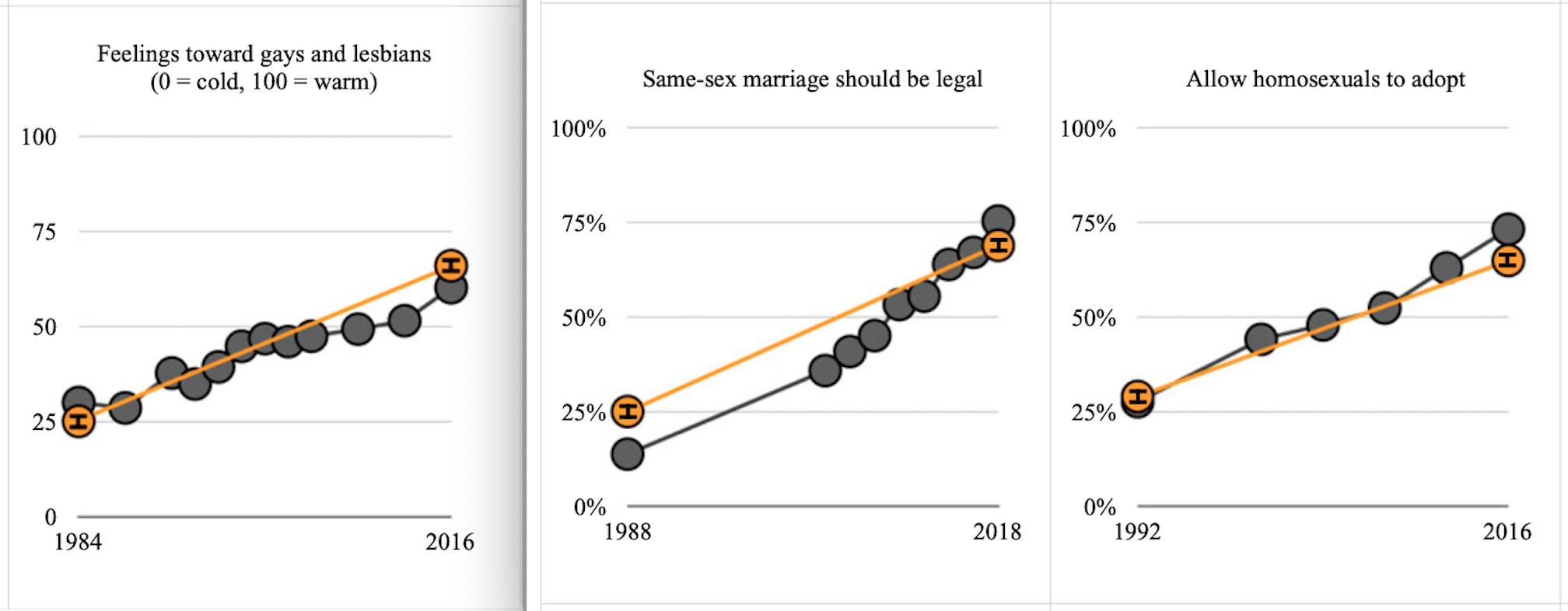
I came out in the late 80s and I remember widespread homophobia, but if you asked me today, I probably would not have guessed that the polls at the time came in that negatively toward gays and lesbians. I have a recency bias about how much things have changed. But I do remember a lot of fear and anger in the late 80s, early 90s— and a lot of violence against gays and lesbians (and bi and trans and queer folks) that was accepted as normal by many mainstream institutions.
I haven’t seen a poll of attitudes towards LGBTQ+ folks in the 1950s, but knowing about the McCarthy era, I’d wager that they’re even lower.
Is this country less safe for LGBTQ+ Americans than a few years ago? Yes. But we’re nowhere near where it was a few decades ago. And we survived those times and learned from them.
Keep connecting and learning
We have a past of brilliant leadership and community building available to us— and more available than ever before. Mark Zuckerberg’s reprehensible changes at Meta, and the President’s involvement in TikTok, won’t stop LGBTQ people from connecting online and offline. (And anyway, I’ve been hearing for years that Facebook is just everyone’s parents hanging out; the youth have cooler places to be.)
Here are some tips for finding safe LGBTQ2SIA+ spaces online:
- Use positive search terms in search engines to find resources.
- Look carefully at results you find. The website should say who runs it and have information about them. It’s tough to avoid spam and fake support right now.
- Go to the websites of organizations you already know and look at their resources.
- Look up queer & trans positive books and then go to the authors’ websites.
- Consider exploring the Queer Liberation Library for online access to a wealth of queer/trans stories.
- Go to Reddit and find well-moderated subreddits.
- Well-moderated is the key! Read their rules and, if possible, what members say about that sub.
- Search Reddit (and the web in general) for queer- and trans-positive Discord servers— then ask for an invitation.
- Read queer & trans books, watch movies, play games— and join their fan communities.
- If you’re 13-24, visit TrevorSpace.
- If there’s a community you want, it doesn’t exist, and you have the capacity, create one! It’s not too hard to pull in online friends, people from other servers/subs, etc.
I’ll be spending much of my online efforts on my website, expanding it as a hub of useful information for the topics I know best— and almost no time on Facebook and Instagram. I’ll link new web posts on those platforms, but if you want to keep in touch with me, I recommend bookmarking my website, subscribing to my newsletter, emailing me, and/or maybe following me on Bluesky where I’m @RachelGoldAuthor. (But I’ll warn you that I’ll still probably be bad at social media.)
Remember that our elders support us
Since we’re not usually born into LGBTQ+ families, we can feel isolated and disconnected from what’s come before. I’ve had the astounding good fortune to work with brilliant minds in the generation before me— and to be emailing with Katherine V. Forrest, Penny Mickelbury, and Judith Katz last year and this. I want to share part of an email I sent back to Katherine and Penny after the elections, talking about the powerful contributions they’ve made and the change created:
Because you came out and have built that community, now there are thousands, likely millions, of young queer and trans people connecting with each other in person and online— and with the literature of our community. This younger generation is much more likely to be out as LGBTQ and has more gender diversity than we’ve seen at any point in the history of America as a country.*
I think I didn’t link to you two the interview that Judith and I did locally. A key part for me was remembering that I’d read Judith’s book in college and that it expanded what was possible for me as a young Jewish lesbian— and then all our work expands what’s possible for the next generations. I remember reading you, Katherine, my first few years out of college, at my reporting job where I got to work with and learn from Penny. We’ve created a present that isn’t all we wanted, but that is a very solid set of steps for the next generations to build up from.
I teach a class that’s attended by a majority of queer and trans kids and we read fifteen weeks of queer and trans literature. This is possible because of the work we’ve all done building this literature, this community, and being out and proud and sometimes mad as hell. If you consider every out, healthy queer/trans kid as a victory, we’ve had a lot of victories.
There should probably be some other rising note here at the end, but I was so praying that we’d get a Black woman president that I’m going to let myself also be tired and sad. I am super grateful to have you in my life. You’re part of what makes me possible.
* Prior to the arrival of European colonialism, the indigenous peoples of North America had an amazing amount of gender diversity. Colonizers worked to wipe this out, but some present-day indigenous communities and scholars are working to rebuild that.
More rungs on the ladder
Ashton here to note that Rachel has served this same role for me, and I’m sure for many other LGBTQ+ youth across America. Hell, even my grandmother is reading Being Emily to help understand transness better!
I want to speak directly to the younger generations right now, as a young person: reading Rachel’s email here made me cry. I cry because the world is scary, and I’m worried about the wellbeing of everyone I love and everyone I haven’t had the chance to love. But I also cry because there is so much pride, community, and hope in Rachel’s words.
I want to encourage you to believe them: there is still hope, even though everything seems grim. We have survived for thousands of years. It won’t be easy, but we will make it. There is so much community to be found across the country. Hopefully, none of you will be alone.
Lean into the wisdom of those who have done this before
We encourage everyone who is able to read the work of queer/trans elders. If you have these folks in your life, talk to them. Share experiences and ask for support if you need it. At some point, we’ll put together a reading list of a few of the most influential people/works for us. Until then:
Mark your calendars for Feb. 18 when Penny Mickelbury’s new book, Payback, comes out. The themes of “Payback” include justice and family, in a community of queer Black folks in 1950s Harlem. It’s a novel in which many things are put right in a world where so much wrong is being done.
Do you have other tips to help LGBTQ+ people persevere in the years ahead? Let me know in the comments on this post if you’re so inclined.
Want to receive once-a-month updates from me, directly in your inbox? Add your email below to subscribe to my newsletter. To prevent spam, you may get a confirmation email asking you to confirm your subscription.
No Comments