
How Video Games Help Me Explore My LGBTQ+ Identity
Growing up, my biological father had a PlayStation and the original Xbox, which was less than a year older than me. Games like Guitar Hero and Crash Bandicoot were social opportunities during the first decade of my life. But it was in fleshed-out, sprawling, lore-heavy single-player adventures that I really felt comfortable. (That’s a lot of hyphens, but I’m sticking with them.)
How did these games help me explore, discover, and understand my queer and nonbinary identities? How might they have the potential to help others do the same? Let’s explore that!
A side note: Rachel has a page here on her site dedicated to their own gaming adventures, for readers who might be interested in characters and games they’ve played. Additionally, the titular character in Rachel’s novel Being Emily (now available as an audiobook) uses World of Warcraft to explore her gender, especially before she feels ready to do so openly.
How it started: first-person shooters and open worlds
You wake up on a ship in the deepest reaches of space. Alarms blare around you, people running and screaming as fires start and explosions rock the ship. You have to get to the captain, who will give you an unloaded pistol and humanity’s smartest AI to face the greatest alien threat the human race has ever seen.
I am, of course, describing the opening sequence of Halo: Combat Evolved. I don’t know how many times I replayed this game before I had even entered my teen years. In a time when I didn’t have ready access to online guides and YouTube videos, I enjoyed exploring every nook and cranny in the game to find Easter eggs like the thirsty grunt.
The Halo universe would grow into one of my fondest comforts, and I still find myself playing the games over and over again. It wasn’t just the clever dialogue and rich story that drew me in; it was the ability to inhabit a persona other than my own. At a time when I was trying to dodge expectations of masculinity, playing a hypermasculine human killing machine somehow felt… safe. I could take on this role of my own volition, rather than being forced into it by others.
Then, there were the (sort of) open worlds. I played Shadow of the Colossus a lot as a child, and either Kingdom Hearts or Final Fantasy, but I can’t for the life of me remember which one. When I got introduced to Minecraft shortly after it came out, I was immediately hooked.
The allure of open worlds has many facets for me, but two stick out. One, the ability to wander endlessly and be immersed in my own thoughts in the safety of an imagined world. Two, the power to create my own stories.
My brain has always thought in stories, and even at a time when I didn’t know what LGBTQ+ identity meant, I knew that my story for myself didn’t match up with the one others told about me. Fictional worlds provided a space for me to experiment with telling my own story in different ways.
Where does gender come in?
Ah, the age-old question: gender?
By the time I played Skyrim for the first time, I was out and proud as gay and nonbinary. I was starting to become discontented with the label of “gay,” and figuring out how to shift to “queer.” But my gender sat comfortably in the middle: not masculine, not feminine.
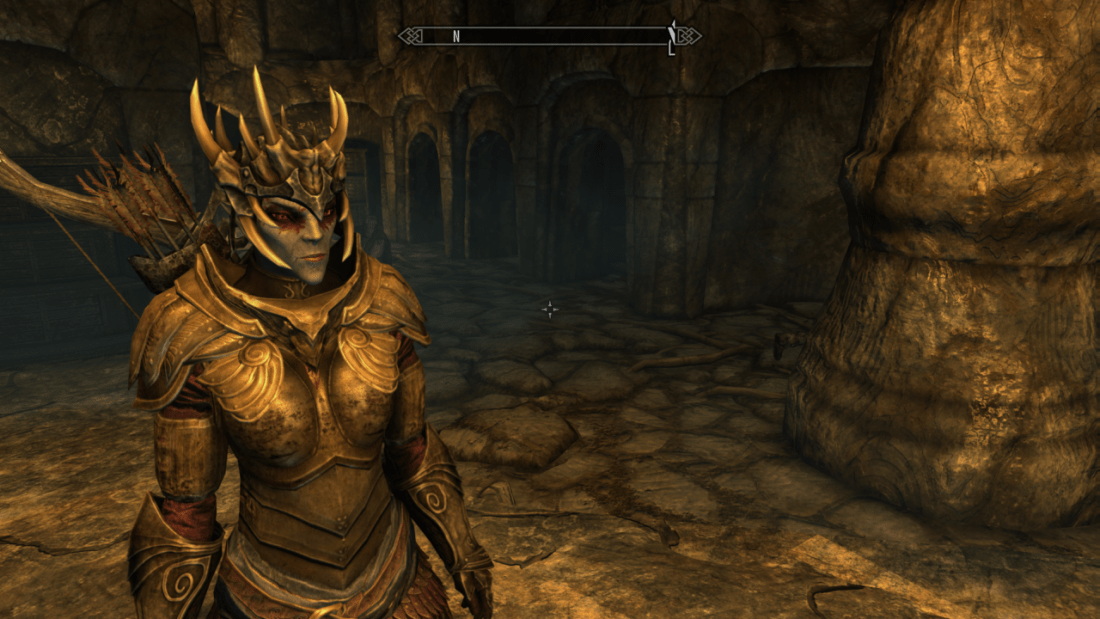
My first Skyrim character, Skela (pictured above), was a woman. A Dunmer stealth archer, the way Skyrim is meant to be played. I did everything with that character, eating up each new quest line with joy. I fell in love with Serana the moment she stepped out of that tomb, and ended up marrying Aela the Huntress, because of course my character wasn’t going to have a straight marriage.
Here’s the thing: I’ve played over a dozen Skyrim characters, not to mention other RPGs. Every time I play a woman or nonbinary character, I give them a deep backstory, a personal drive, and lose myself in their role-play.
When I play men, though, they fall into two categories:
- Haha I’m just a silly little guy (like all of my Skyrim mages)
- I’m a big, strong man who likes breaking things (looking at you, Master Chief)
Despite the generally positive reactions I got to coming out as nonbinary, I still felt trapped in one expression, one identity. My ability to explore femininity was limited. But every time I loaded Skyrim, I got to take on a female identity and imagine what that would feel like. (Albeit with magic, dragons, and heaps of morally questionable choices.)
It was this exploration, coupled with Rachel’s book Being Emily and a circle of very supportive friends, that would eventually lead me to start using she/her pronouns and try out a different name (again). That didn’t stick, and I now feel even more comfortable in a fluid, shifting approximation of androgyny. But it was vital exploration that helped me find and accept myself. It was time spent respeccing my character until I felt comfortable.

My Starfield captain, Jayce Lasky. Bonus points if you know what inspired the name! 
My iconic Minecraft character: Steve But Slightly to the Left 
One of my many Skyrim vampires, with my favorite mount, Arvak. 
The color scheming and style for my Aragami 2 character. 
Kassandra from Assassin’s Creed Odyssey; one of the most Gender characters I have played.
Is it representation or role-play?
You may have noticed that all the games I’ve mentioned have few, if any, canon queer characters. Finding trans video game characters is even harder, which is why I was so delighted to stumble across Tell Me Why a few years back.
And this is where I want to acknowledge an important discrepancy within RPGs: many characters are “playersexual,” not actually written to have an LGBTQ+ identity.
Consider Skyrim, where any of the romanceable companions can be married regardless of your character’s gender. However, none of these characters have queer histories, speak of queer identities, or otherwise present as queer. Likewise, they usually don’t present as straight. They’re simply attracted to the player for the convenience of the game.
Don’t get me wrong, this was a really great step that continues to allow queer people to role-play stories that reflect their identity. But is it actually LGBTQ+ representation?
There are games that do it better. The Dragon Age series has a host of LGBTQ+ characters, with two canon trans characters. Starfield gave the romanceable companions slightly more complex sexualities and included queer characters throughout the game. The newer RPG-style Assassin’s Creed games allow for a variety of queer encounters.
Hades is an obligatory mention, and it makes sense, since its mythical source material is already coated in queerness. The game’s protagonist, Zagreus, has romantic interest and history with multiple characters, and each of these characters has a fleshed-out backstory and sexual/romantic identity.
Beyond canon: creating your own stories
One of the wonderful elements of video games is that no two players have the same experience. Even in linear, contained games, there are so many choices and interpretations that really depend on the player.
So yes, many video games don’t include LGBTQ+ representation, although queer presence in gaming is evolving. But, as I’ve done with so many games, that doesn’t mean you can’t queer the game yourself.
I want to give one more example: the short, succinct, emotionally devastating story of Aragami. When I first started this game, I didn’t expect much of it, but I fell in love within the first two missions.
Aragami tells a story of darkness, connection, and betrayal. It balances terrible tragedy and compelling mystery on a kunai’s edge. There isn’t really any romantic plot in the game.
And yet, in Aragami’s shadows, I found more questions to ask myself: What do I believe in? What, or who, would I fight for? How do I want to connect with others?
Humanity’s capacity for connection never ceases to amaze and confound me. Aragami only added to that. In order to understand my LGBTQ+ identity, I have to continue examining what connection means to me, because part of how I define myself is in the way I connect with the world around me.
Sometimes it doesn’t have to be about exploring your own identity. It can be inhabiting a character you don’t resonate with, just to explore a different perspective, like I do with Master Chief. Or, you can take on a persona that doesn’t fully match your identity, but wrestles many of the same questions you do, like Kril in Another Crab’s Treasure. (Note: this game will make you cry.)
However you choose to game, I hope you’re able to find a similar sense of wonder, exploration, and connection as I have. Virtual worlds provide fantastic landscapes for telling stories that resonate with us. You just have to find the ones that set a fire in your heart.
What are your favorite video games to use for self-exploration? Or just to play in general? I’d love to hear about them! Leave a comment below or find me on Instagram or Facebook.
No Comments