
Meshing Transness and Tarot: Morgenstern’s Phantomwise Deck
I came out as nonbinary before I ever encountered a Tarot deck. So, when I got my first deck (my now loathed Rider-Waite-Smith deck, which I have long since gifted away), I found myself struggling with the rigid gender binary it created.
On one hand, I did (and still do) believe in some tenets of masculine and feminine energies, although not with many of the meanings commonly associated with them. On the other, I found no place for myself in a deck made up of Man and Woman, as I am neither, or perhaps a bit of both. This is only made worse by our modern words for these energies being tied up in our conceptions of gender identity, and not having alternative language to identify them with.
This divide would continue within me for years, serving as a barrier to my full access of the Tarot’s knowledge. Until, a couple years ago, I received Erin Morgenstern’s Phantomwise Tarot. This deck helped me reconcile my transness with the esoteric mysteries of the Tarot, and has deepened my relationship with my other decks. To illustrate the power of this deck, I’ll walk through some of my favorite cards and explore what they each mean to me.
The Phantomwise Tarot Deck
Erin Morgenstern is the author of The Night Circus (my all-time favorite book) and The Starless Sea. While working on early drafts of The Night Circus, she hand-painted a Tarot deck that took inspiration from her work as well as other sources. From her site:
“The Phantomwise Tarot is a little bit circusy, a little bit Wonderland, and a little bit black-and-white phantasia of its own invention. It is loosely based on classic Rider-Waite-Smith tarot imagery though here there are also ballerinas and pirates and fluffy bunnies and curious cats to help you ponder your questions while you seek your answers.”
While being loosely based off the Smith deck and using many of its gendered assumptions, Morgenstern is very careful to avoid concretely gendering her cards. Throughout her guide book, she either uses no pronouns to refer to the card’s figures, or exclusively uses they/them pronouns. Making this, effectively, a nonbinary Tarot deck.
But this doesn’t mean the masculine and feminine energies have been removed from the deck. As you’ll see, Morgenstern finds a way to incorporate them without always tying them to our conceptions of gender.
Major Arcana II: The High Priestess

For this first card, I’ll copy Morgenstern’s description from the guidebook:
“Between two columns, one black and one white, a figure sits, existing in the space between. One eye is covered, looking only inward, while the other looks outward. A book sits open, waiting to be read by the light of an impossible moon. Here is the guardian of secrets and solitude and hidden things. A time to pause and contemplate and understand what it is being sought. To plumb hidden depths and ponder mysteries both new and ancient.”
Here on this card sits a stereotypically feminine figure, accompanied by the gendered name of High Priestess. Yet rather than being explicitly a woman, this figure sits “in the space between.” A space that I have found myself in all my life. A guardian of secrets with an impossible moon—here I feel the classic feminine energies of moon and mystique, but under a new name.
This was the first card that allowed me to accept those energies as a part of my trans self, but certainly not the last.
Major Arcana XVII: The Star
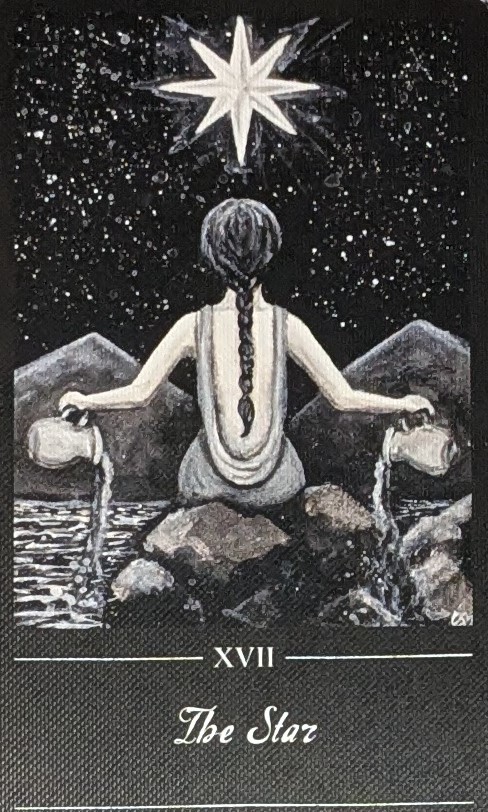
Here again is a classically feminine figure. Or is it? Sure, to Americans the long braid may suggest a woman, but could this figure not be androgynous?
To me, this card presents a space of sacred androgyny. Two pitchers, perhaps just water, perhaps the fluids of life. A suggestion of the balance of two forces, without a lean towards one or the other. A bright star overhead, lighting the landscape as one reflects. An “opening of hearts” and of minds, a space to exist comfortably as you are.
Major Arcana VI: The Lovers
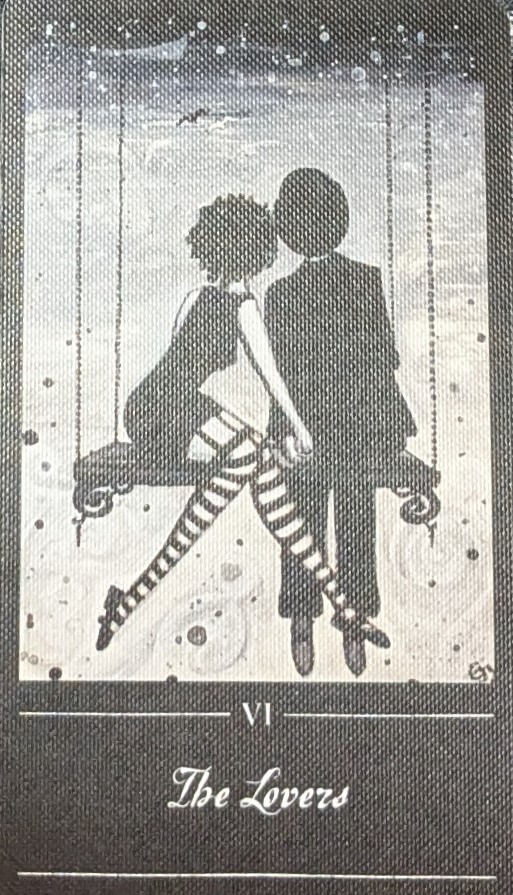
Once again, a reader may instantly assume this couple to be a man and a woman. But who is to say the figure in the suit is a man at all? Their faces turned away from us, we only have their silhouettes. The suggestion of a form; perhaps anyone could fill the space they are in.
In Morgenstern’s lovers, there is a “harmonious balance.” This theme of balance is one she returns to again and again. While many forces in life need balancing, one notable set is the masculine/feminine energies. It is through this deck that I fully understood that these energies are not tied to our modern diagrams of gender identity—they are something deeper, older, and both reside in each of this. To balance these forces, as the lovers do, is to achieve harmony with one’s identity.
Major Arcana XIII: Death

Now we have another figure with their face obscured. An androgynous figure, scythe carefully balanced on their lap, black and white alternating on their large umbrella. The face of death is unknowable, perhaps until the moment we meet it. This is a figure of “new things,” “new growth and rebirth.”
If one of the world’s greatest forces, the ending of a period or a life, can be androgynous, why can’t I? Here I do not see a blending of masculine and feminine energies but an absence of both. Death comes for all, and carries no concept of life’s energies in its wake.
The Six of Cups

Last, but certainly not least, a tea party with rabbit friends. The bunnies are playful, full of “whimsy and wonderment.” One sits in a cup, another drinks politely. These bunnies have no idea of our gender structures; they carry all of life’s energies in harmony within themselves, and they are happy because of it.
The figure pouring the tea is, once again, an androgynous one. They are young, perhaps representing an inner child to be reconnected with. Here I feel more balance and harmony than anywhere in the deck, for there is no sweeter harmony than being able to revel in whimsy without fear or regret.
Rachel Pollack: maybe Tarot comes from the future
Rachel here to add one of my favorite ideas from Rachel Pollack (though I have many): that the Tarot comes to us not from the past, but from the future. Rachel Pollack was (and in my experience still is, even after her death) one of the world’s foremost authorities on Tarot, as well as being a trans lesbian. Her many decades of work with the Tarot have encompassed a variety of trans and genderfluid interpretations. I highly recommend her books and we’ll be including more of her wisdom on this site.
Starting with this astounding and beautiful idea, based on the notion from physics that equations don’t have an arrow of time, she writes:
“Events occur through a process called ‘transactional interpretation.’ A wave ripples out from the present moment, the now. This wave must meet a resonating wave from the future. The interactions between these two waves produce a probability field in which events occur. At any moment the future is as real as the present. The future can cause the past as much as the past causes the future. In fact, neither one causes the other, they exist in a relationship that goes in many directions at once.
“All time, all events, exist and influence each other, but none of it controls us. …
“Suppose our collective beliefs about the Tarot as the key of keys … somehow reached back in time to draw the Tarot into existence in Renaissance Italy? When Court de Gebelin proclaimed the Tarot the Book of Thoth, the idea took hold so powerfully because it ‘already’ existed in the future.
“We, all of us, caused the Tarot to come into the minds of the cardmakers in such a perfect form and structure that in our own time we can adapt it to an almost endless series of esoteric, mythological, and cultural ideas. My friend and fellow Tarotist Zoe Matoff points out that our own view of the Tarot may come from future generations who need us to believe what we believe for them to develop their own ideas.” (A Walk Through the Forest of Souls, 20-21)
This is an awesome idea to apply to Tarot—and also to our lives. What are the futures reaching back, waiting to be born in and through you?
Do you have thoughts on that question, or on transness and tarot? We’d love to hear them! Leave a comment on this post if you’re so inclined. Also, want to receive once-a-month updates from me, directly in your inbox? Add your email below to subscribe to my newsletter. To prevent spam, you may get an email asking you to confirm your subscription.
No Comments