
Neurodivergence Without Shame, Part 1: Un-Shaming Ourselves
Editor’s note: This is an edited transcription of a conversation between myself and Rachel. It is the first of four posts made out of this conversation. Anything in brackets is content I have added in editing. Occasionally, I left in our repetitions, stutters, and verbal idiosyncrasies to better reflect how we both talk. —Ashton
Introduction: Framing the conversation
Rachel: I’m here live with Ashton representing two generations of neurodivergence and queerness. We’re both educators and we’re here to talk about our lives and being neurodivergent without shame. Do we want to start with personal stories?
Ashton: Yeah, obviously people know you and maybe, somewhat, me, but more background around this conversation specifically is good?
Rachel: I was informally diagnosed with ADHD in my mid 20s – and formally diagnosed in my early 30s, so almost 20 years ago. I was lucky in that I managed to find some positive information about ADHD, and it explained a lot about my life and helped me work more effectively.
Rachel: My official diagnosis from the clinic that I went to in Minneapolis was ADHD and anxiety with OCD traits. I think many people in the neurodiversity community will agree that anxiety/OCD part is probably code for “Autistic in someone assigned female at birth.” Because 20 years ago, you were probably not going to get an autism diagnosis if you were assigned female at birth and didn’t have significant, obvious support needs.
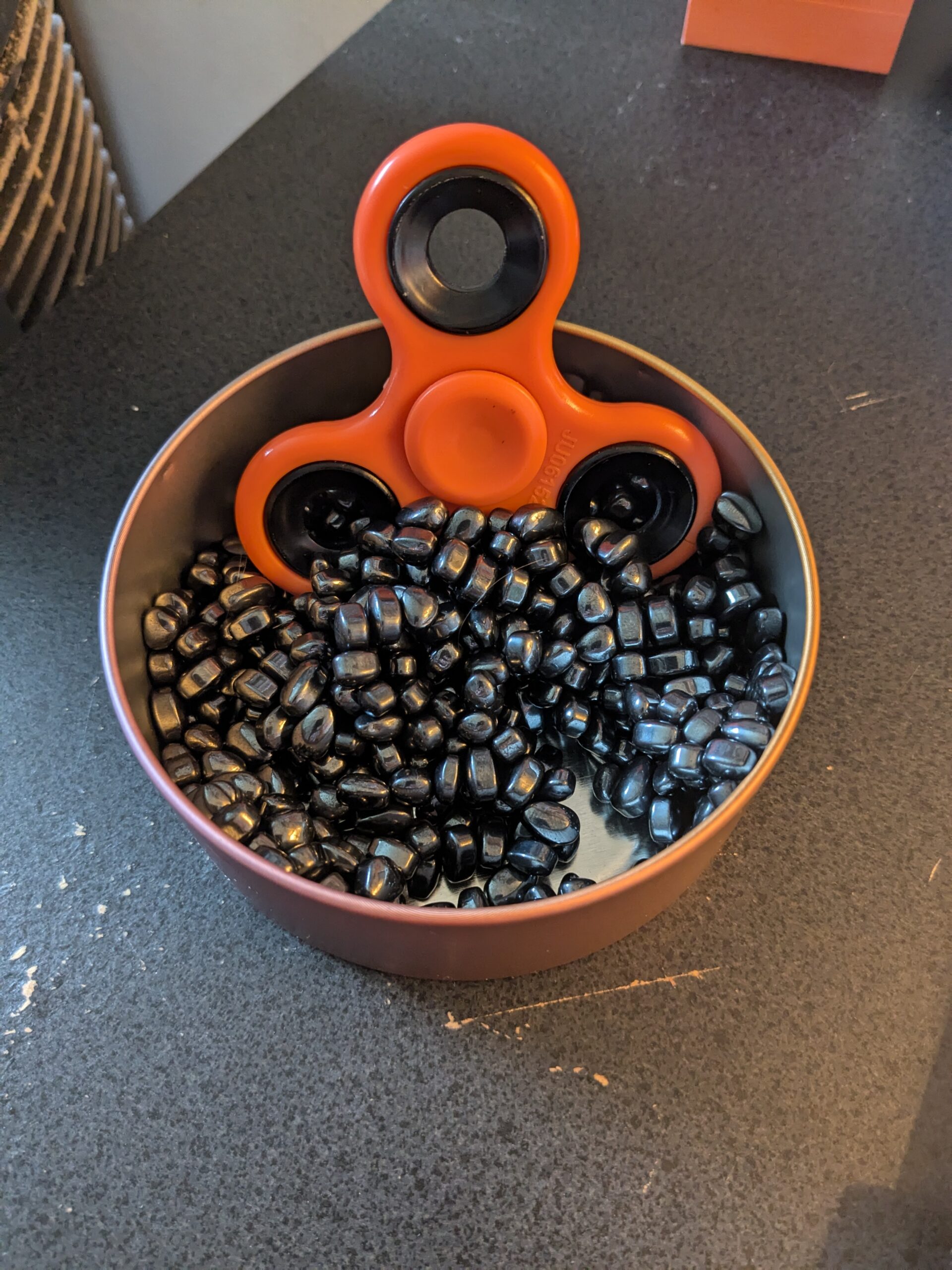
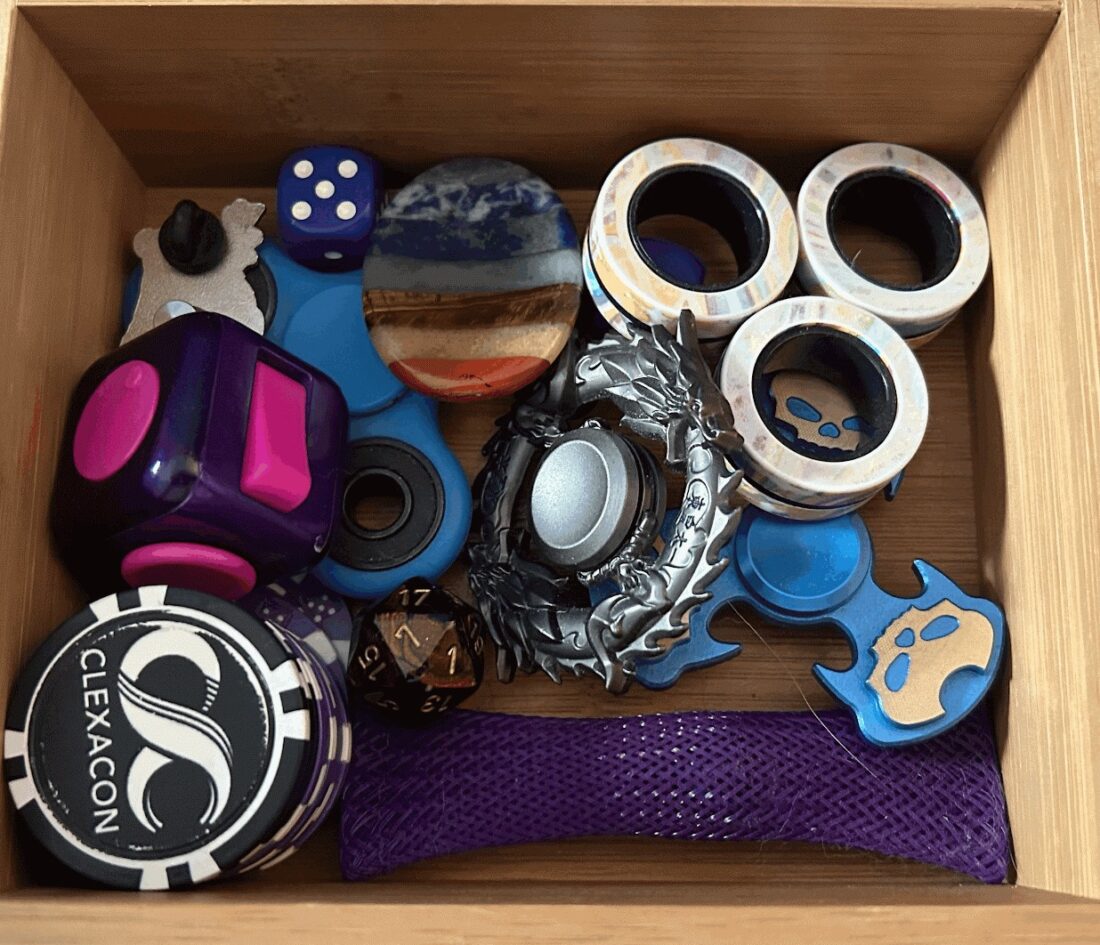
Rachel: It’s been an interesting journey to be thinking: yeah, ADHD for the win, I’ve got this! And then coming into: oh, AuDHD is a thing. [That’s Autism + ADHD = AuDHD.] I’ve been seeing the other parts of my life that were not being supported that could now be supported. That is my short version of the story as I go for the bowl of fidgets.
Ashton: Yeah, I also just grabbed one.
Rachel: We should probably leave that in the transcript. Oh, no, this one isn’t clicky. Oh, there we go. Better now.
Ashton: I do not have an official diagnosis of either ADHD or autism. My mother has ADHD, as does my oldest sibling. But I was never tested, because my parents only realized their mistakes [once] I was grown up. And I haven’t gone for an official diagnosis at this age because of ableism and not thinking it’ll really help all that much.
Ashton: But I am very likely Autistic. I have scored the requisite amount on the RAADS-R as well as being peer-reviewed by many others. Still something I’m very much figuring out, and there may be some ADHD thrown in there. It’s hard to tell. I also do have an official PTSD diagnosis, which I had got in mid 2021. So I would have been… 18 or 19, I don’t remember. So official PTSD diagnosis, which is somewhat up there with the neurospicies and makes figuring out the other stuff harder as well.
[I often use the term neurospicy in place of the term neurodivergent. Both refer to brains that process, think, and/or function differently than the accepted “norm” for brains, known as neurotypical.]
Rachel: I’ve read that PTSD and ADHD can cause a lot of the same impacts.
Ashton: And the kind of masking that comes with the PTSD makes it difficult to learn unmasking and also figure out like, what traits I might have been suppressing in my childhood. So it’s very much an ongoing process of learning.
Rachel: I think anytime anyone sees themselves represented in the neurospicy community, and being open to asking: well hey, what works? I can look at my official diagnosis— I’m saying that in a silly font— and think: oh, yeah, that probably is AuDHD. But also more importantly, when I read the AuDHD tips they’re so incredibly helpful. There are a lot of reasons not to get an official diagnosis and I think self-diagnosing can be very valid. One great way to do it is look for what works.
Ashton: Yeah, there’s a lot of creators online that have really helped me with that. I mean, you were also helpful with that. Because there’s a lot of creators that have really helped me both realize the validity of self-diagnosis, and with some of those tips and things.
[A few of the people I was referencing are Rebecca Faith Crews, Toren Wolf, Neurodivergent Lou, and Morgan Foley.]
Rachel: There’s also language around being an empath or being a highly sensitive person (HSP) and in some sense any name that feels comfortable to you is a good name. The payoff comes in the implementation of what makes your life better.
Ashton: Yeah.
Rachel: Instead of getting hung up on asking: okay, exactly what is the right thing?
Ashton: But I think another beauty of it is getting to surround yourself with more neurospicy folks. Like my friend group, I think I have one neurotypical friend— he’s also my one straight friend. So he’s like the token one in the group. And I had a really great therapist that I worked with for a couple years after coming here. But they were not as versed in working with neurodivergent folks and had some somewhat harmful things to say about it. Which they later realized was a mistake, but I actually ended up switching to a new therapist this year because of that. And that has been really helpful to have a neurodivergent therapist who’s able to help talk me through some of that journey.
Rachel: Yes, absolutely.
Ashton: Now that we’ve given our lengthy introductions: For a lot of neurospicy folks at all stages of life, there’s a lot of shame that gets put on them by others, which they then internalize. So we’re here to talk about that. And talk about some ways to deal with that. And also like, just be cool humans. And pet dogs, because I’m kind of distracted by that.

Learning to un-shame ourselves
Rachel: I’ll start by saying that in the last month, I learned the word “floordrobe.”
Ashton: Is that like—
Rachel: It’s the wardrobe that’s on your floor. I felt so seen. I think unfortunately I was reading it in a context that was discouraging one from having a floordrobe. But I’m pro floordrobe! Sometime in the last decade, maybe longer, I accepted that I’m going to have clothes on the floor for the entire rest of my life. Now I make a space for that instead of trying to not do it. It takes too much cognitive power to not do it. It doesn’t feel good.
Ashton: I think there’s a lot of those things that we’re kind of taught are what you’re “supposed to do”— big air quotes here. Like, you always have to make your bed.
Rachel: Who does that?
Ashton: Right! Like, I have not made a bed— Okay, I did make a bed in April because I was staying with my grandparents, but other than that, I have not made a bed in like two years, because it’s not worth the effort.
Rachel: In my mind, the right way to make a bed uses a blanket that’s to keep animal stuff from getting [on] my actual bedding. I just throw that over everything, and the bed is made. Keep the animal stuff off my linens. Done.
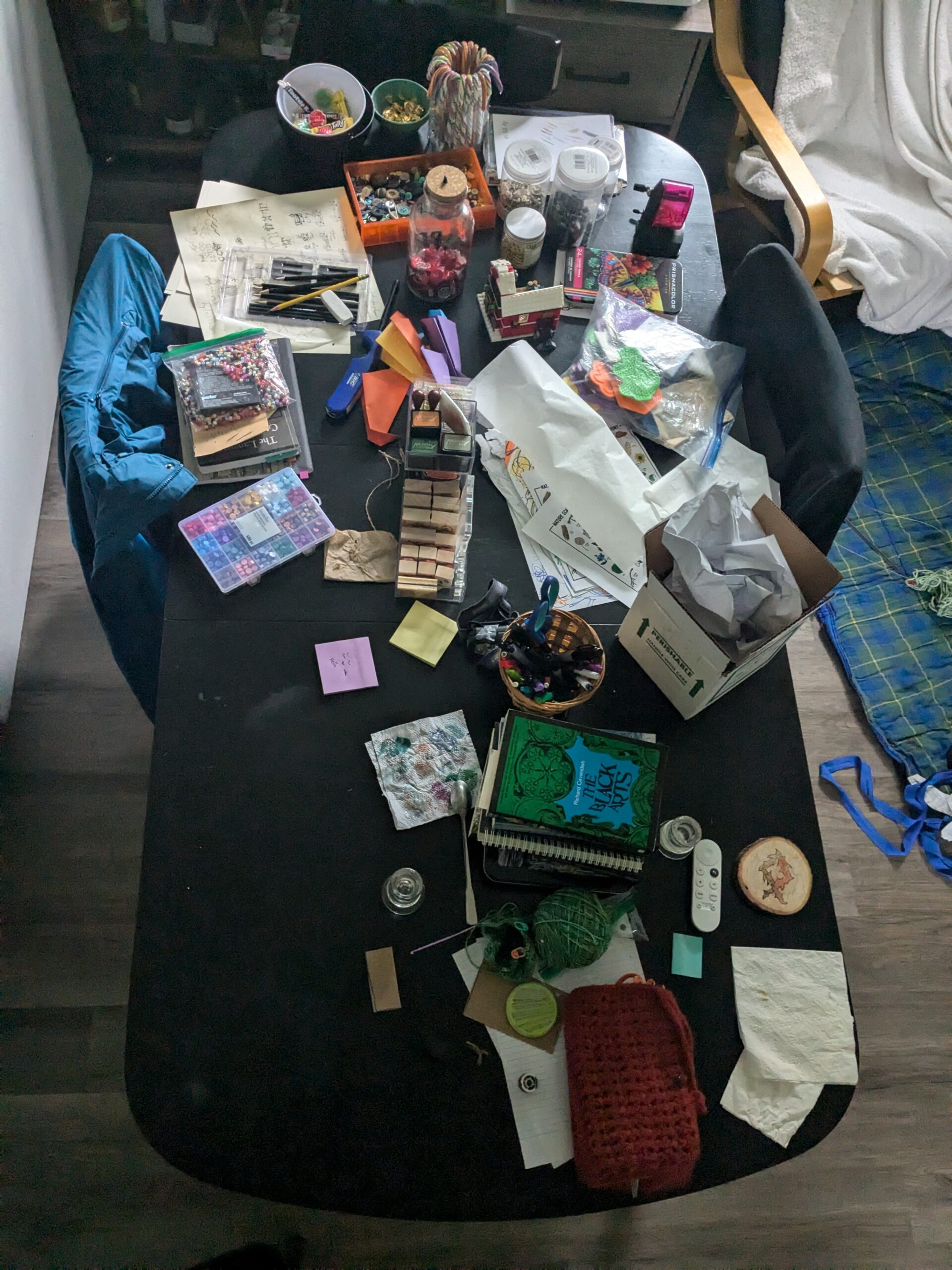
Ashton: And I similarly have a table in the living room that is just covered in all kinds of crafts materials. I just leave them there until I need to move them for something.
Rachel: I’ve seen that table, it’s very cute.
Ashton: But my floors stay pretty clean, because I just don’t want to trip on things because I have a small place and chronic pain.
Rachel: That’s the thing. It’s not about being clean or messy. It’s about what do you need in your space? What does your space need? Part of how having been shamed shows up for me is if I am persistently asking, “What’s wrong with me that I can’t do this thing?” That’s a place to go on a little archeological dig.
Rachel: One of the interesting things that I read in the AuDHD community is that a lot of times, if you have both ADHD and autism and the ADHD gets medicated, that’s when the Autistic traits can show up really. And I’ve been medicated for about 12 years–I can focus and work better–but then I keep asking: why are there all these other weird things about me still? Why am I still weird, if I’m taking this medication? It’s because AuDHD is awesome.
Rachel: So one of the things for me lately has been, I can’t do a number of things involving people back to back to back and not get exhausted. And I’m like: why are people wearing me out so much? Oh, because it just takes a ton of processing. I’m good at people, but it takes a lot of processing power for me to do it. Then I gotta nap for a while. When I give up thinking it’s wrong or weird, I can organize my life so it works for me.
Ashton: I think the structures that provide that shame, right, like, whether it be from our families or teachers or therapists, there’s kind of this underlying assumption that that is what gets people to be “better.” But long term, shame doesn’t work. It just creates cycles that end up making it harder to live your life and do the things you want to do.
Rachel: And you can shame people into masking. But then long term, that is not good for any kind of health.
Ashton: That’s something I have been thinking about a lot when I’m faced with a situation where I’m like, oh, why can’t I do x? And this might also be for physical disability as well. Is trying to ask that question less in like, oh, I should be able to do this, why can’t I do it? And instead focusing on like, what is showing up in my body that is preventing me from doing this right now? Is this something I should not be doing? Is this something I need to do later? Or is it something I need more support to do? If it’s something I really want to do, you know, how can I make that work? Or if it’s something I don’t want to do, do I need to do it?
Rachel: We did the blog about the Nap Ministry and the evolved nest. And I spend a lot of time thinking about the evolved nest and how humans — we see this in a lot of the health problems today — have evolved to move so much more than modern humans move. And so that helps me recontextualize fidgeting. Instead of fidgeting being like: oh, I’m a dorky kid who can’t focus. It’s like: oh, I come from hundreds of thousands of years of evolution for bodies that were made to move, and do not like being still for long periods of time and therefore I will enjoy this fidget. I come from an evolved lineage of people who like to play. As an author I feel that having a good story context for ourselves and our brains can be really supportive and healthy.
Ashton: Yeah. I fully support that. But I also write a lot, so maybe it’s a writer thing.
Rachel: Readers, your mileage may differ.
Ashton: Another aspect of that, which I’ve been thinking about, is, I have a friend— who, we used to call them our “crafternoons” now we call them our “autism afternoons.” But we basically just hang out, usually at my place, and we have snacks and we put on a baking show. We both do our own little crafts.
Ashton: Our neurotypes just kind of play off each other really well. One of my favorite things — like, they’ve been a large part of my journey of learning to accept my own needs and stims. They echolalia a lot. It’s like, we’ll be watching a baking show, and they will echo something that somebody on the show said, and then I will echo them saying it. And it’s just kind of a really fun moment where we both feel comfortable enough to just allow this to happen. And neither of us really feel bad about sharing access needs with each other. Like, ever. And I think one of my favorite phrases they’ve said to me is “canceling plans is sexy.” Having to be like, you know what, I’m not feeling it today.
Rachel: Canceling plans is sexy. And, it makes things safe for everyone because everyone has life events happen. Neurotypical people catch colds and have accidents and have things come up. And like the safest relationships are the ones where people say: hey, I can’t do this, or I can come over but only for an hour or whatever.
————
And that concludes the first part of our conversation about unlearning shame and exploring our relationships to neurodivergence. In part two, we’ll talk about the complexities of different neurotypes and listening to your bodymind. Stay tuned for that, and follow Rachel on Instagram or Facebook if you want to know when it’s posted! If you have any moments of unlearning shame you want to share, we’d love to hear them in the comments below.
No Comments