Super Gay Poems: Interview with Stephanie Burt
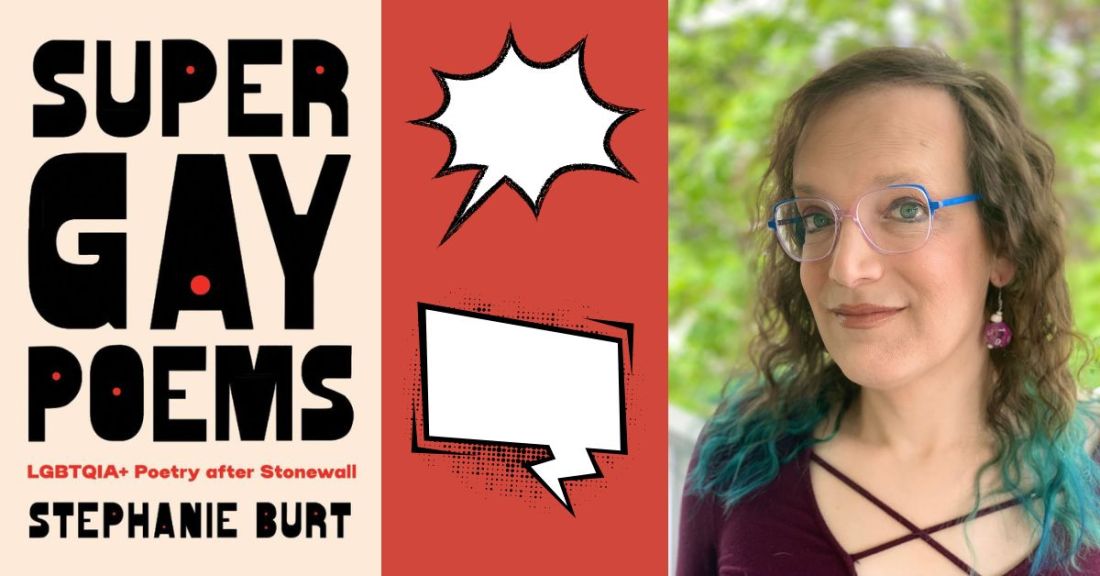
This is an interview with poet and literary critic Stephanie Burt about her newest book, Super Gay Poems: LGBTQIA+ Poetry after Stonewall. On top of being a writer, critic, Harvard professor, and all-around literary star, Stephanie is also a close friend. She is a companion in all things nerdy and trans, and I enjoyed the chance to ask her some questions about this exciting book.
Super Gay Poems is, from its Harvard University Press listing, “a groundbreaking anthology edited by acclaimed poet, critic, and scholar Stephanie Burt,” which “brings together fifty-one works encompassing the wide range of queer and trans verse after the Stonewall uprising of 1969. Since that galvanizing moment, poetry has served as both a vehicle for queer liberation and a witness to its sometimes fragile, sometimes ebullient flourishing, across the world… Each piece is paired with a concise, eye-opening essay in Burt’s trademark style, with verve and an inimitable literary ear.”
Table of Contents

What do you hope LGBTQ youth take away from this book? What can we learn about resilience & movement building/thriving from these poems?
I love that question. Thank you! First, the poems show that we have a history. A capacious one. And they show how much can change, so fast! There’s such a distance from Adrienne Rich, who wants to imagine a women’s country full of political lesbians playing folk music, to Tonee Moll’s apocalyptic beach house. They also show how much we have in common, not just with prior generations, but with other people, especially other queers, who may seem far from us in background, in affect, in desires, in concerns. Audre Lorde’s poem about sharing a house and a garden with a lover looks back to the very earliest love poems in any language. And forward to Moll, and to Chen Chen.
What fictional characters do you imagine reading this book and what would they find in it?
It is, of course, a book intended for Kaz and Aisha from In the Silences to read, and share. And post about on social media, once they feel ready. Outside the Novels of Rachel Gold, though, I imagine other characters reading it too. Here are a few:
Grace from Tillie Walden’s On a Sunbeam discovers the book in a library of ancient work, since she and her gf Mia exist in a far, spacefaring future. She gets really into it, in the same way that some of us today get really into classical Greece, or ancient Assyria. Her favorite poems are by Audre Lorde and Stephanie Dogfoot Chan.
Maggie Tulliver from George Eliot’s The Mill on the Floss finds a time-displaced copy some time before she makes the series of disastrous decisions that she ends up making with Stephen Guest. Maggie decides that maybe she’s bisexual, sets off for Edinburgh (not London), becomes a schoolteacher’s assistant, has at least one hot affair with a slightly older Scottish girl who’s traveled across the seas, and ends up as the lifelong companion of– and if you know George Eliot you know what’s coming– an unusually sympathetic man with an elite education and a small inheritance. Still bisexual though. She likes the Marilyn Hacker poem. The Ruth Vanita poem, too, though she’s not sure why it speaks to her so strongly– it’s not like she ever spent time underwater.
Xûan Cao Manh from Marvel Comics’s New Mutants and X-Force gets really into it. She’s fascinated by the Roque Salas Rivera poem, and by Samuel Ace, since she thinks all the time about how her queerness interacts with her ability to literally occupy other people’s bodies, and with her binational, multilingual identity. She shows the book to Dani Moonstar, who thinks it’s OK but wants more nature poetry and honestly prefers narrative, and thinks about which poems it’s safe to show Rahne, before letting Dani decide.
If you could’ve put one of your poems in, which would you have picked?
Either “Bleeding-Hearts” or “Before the Wedding.” You can find “Bleeding-Hearts,” a poem about supporting queer and trans youth, on Plume Poetry. It looks like you can’t find “Before the Wedding” on the open Web, but you can find it in my book We Are Mermaids.
What has surprised you most while working on this collection?
The biggest book-wide flat-out “oh!” moment came when I realized how many poets, of the 51 here, had changed pronouns either after the poem that I chose first appeared or after I started writing the book (but before it went to press).
The other happy surprises just came as I found individual poems and poets I had not known before. My favorite Mark Doty poem, which I included here, seems to me much stronger than most of the earlier Mark Doty poems that get anthologized constantly. Also, I learned about the poetry of Ruth Vanita. And Melvin Dixon, whose work I should have known much earlier but… (trails off). Also, Jillian Weise’s new book appeared just in time for me to put cy into the book! That’s a good surprise as well.
I was anti-surprised— as in, “oh, I guess that’s how it has to be”— by the demographics and regions and nations and styles I had to decide to leave out. So many poets and poems *could* have gone in. But I couldn’t include them all.
To you, what unique advantages does poetry have in supporting LGBTQ+ movements and culture?
Poems (at least short ones) have the lowest capital requirements of any art. They’re easy to share, copy out, and quote, too. You don’t even need streaming audio. All you need is the ability to read.
What poem/s in this collection left the biggest impact on you?
O’Hara’s, because I encountered it (I think in the old Richard Ellman Oxford Book of American Poetry) in my teens, before I knew I was gay (or a girl). I felt both very much seen, and very confused, since I knew I didn’t want to kiss guys: how could I be gay, or (as O’Hara put it) homosexual? Well, now I know.
Cherry Smyth, because representations of psychological and physical abuse in queer households are So Rare. We need more of them. If you’ve known anyone in that kind of situation, you know why.
Danez Smith’s, because (on the one hand) I think— if I understand the poem correctly— that I’ve been in a similar dilemma, and (on the other hand) there’s just so much in the poem that’s beautifully specific to Black inheritance and to Black girlhood, much that I could never find or even slightly try to comprehend without this poem. That poem is so good, people. Start there, if you want one place to start.
I hope you enjoyed this interview with Stephanie, and you should definitely go check out her book if you’re interested in learning more! Have more questions about LGBTQ+ poetry or Stephanie’s work? Let me know in the comments on this post if you’re so inclined.
Want to receive once-a-month updates from me, directly in your inbox? Add your email below to subscribe to my newsletter. To prevent spam, you may get an email asking you to confirm your subscription.
No Comments